-logo-rev.png)
Best Practice Day Oamaru - 17 March 2026
- FCANZ

- Jul 3
- 3 min read

Being on the FCANZ Board and based in the lower South Island means I organise the Best Practice Days in this region. I was in Christchurch for the weekend prior, so I drove down to Oamaru from there to organise the day.
First up, a call into Farmlands in Temuka to pick up Strainrite irrigation parts, to demonstrate how pivot irrigators can safely cross electric fence lines. From there, I visited Point Lumber, where I was given a tour by Manager Andy Gillespie, who showed me around their post production process, including how they lathe and chamfer their posts. Understanding how posts are made gives better insight into how they perform once in the ground, and these guys produce a very high-quality product.
By Monday afternoon, it was straight into setup with local fencing contractor Mark Ewing, driving posts and preparing demo sections. One demonstration fence line was a netting fence with a hot wire. We used a full 1.8m x 150mm round post driven into the end of a horizontal stay, avoiding joins or cuts where possible.
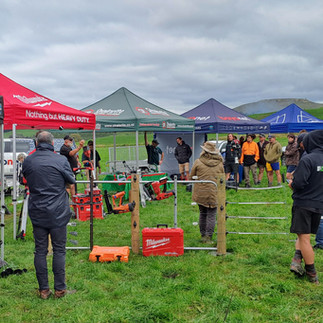
Tuesday delivered ideal weather conditions for hosting a Best Practice Day. The site struck a good balance: accessible from the road, with enough space to run demonstrations, and importantly, it wasn’t wet. Again, we had John Noakes as MC, which is always appreciated.
We covered wire setup, insulators, and irrigator crossings. Struan from Strainrite reinforced a simple but critical point: if a fence line has been adjusted so a pivot hits it at 90 degrees to enable a smooth crossing, the post should be painted white to prevent machinery strikes, especially during night work.
Another session covered straining methods, tie-offs, joining netting ends, and maintaining long-term tension. There was strong discussion around removing stay wires at tie-off points, and the best approaches for repairing broken wires in existing fences. Different crimping tools using Strainrite and Milwaukee gear were demonstrated, showing fast and efficient methods that are becoming increasingly common on site.
After a nice lunch cooked by the local Farmlands team, we watched crews from Custom Fencing and Precise Fencing install box stays, angle stays, breast block, and tie-back stay assemblies. Brendon Crequer from Waratah also contributed a steel angle stay; it was valuable to see a steel option in the mix.
Using a winch, we tested each stay individually, measuring the load before failure. Ground conditions played a major role. Compared to firmer areas like last time in Cromwell, the irrigated dairy soil in Oamaru was soft, reducing holding power. The testing clearly showed that longer strainer posts, or even doubling up box stays can significantly improve strength. It reinforced the importance of matching stay systems to soil conditions and fence demands, rather than relying on habit.
Again, a big thanks to Point Lumber for supplying and delivering quality posts and to Bayonet for donating sheep netting for these demonstrations.
The day also opened up wider discussion around where the industry is heading. Technologies like Halter and eShepherd are gaining traction. While they may reduce traditional fencing in some applications, they’re not removing the need for skilled fencers. It’s important that we are keeping our eyes open on these new technologies coming into
our industry.
Recent fuel cost increases and contractor pressures were also discussed, with valuable insight shared across the group. These conversations are a key part of the day and directly relevant to running a business.
With around 60 attendees, including two school groups, the Oamaru event had a strong turnout and engagement. These days work because of the collaboration between contractors, suppliers, and sponsors.
A special mention to Nick Terry from Custom Fencing for transporting the FCANZ site trailer from Dunedin, and to Brendon Crequer from Waratah for taking it on to Amberley for the next event.
If you’re in the industry, these Best Practice Days are worth your time. They’re practical, relevant, and built around the realities of the job.
And if there’s something you want covered next time, please let us know. These events are only as strong as the input from the people on the tools.
Written by Ruben Connelly





Published in WIRED issue 81/June 2026 by Fencing Contractors Association NZ
You may also like: Whether or not, we fence
© Fencing Contractors Association NZ (FCANZ)


